 +
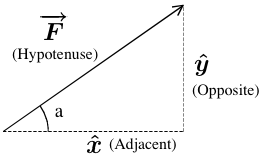
+  form. This, in turn, will allow us to add together all the forces acting on an object, even when those forces aren't obligingly lined up along the axes. and components of the force
  that makes the hypotenuse. You can then use trig to solve for the components.
 = (-43.3 + 25). The component I just found must be balanced by the of the other ; it should be 43.3. Now, I can use trig ratios again to find out how strong the other force is, and then what its y component is: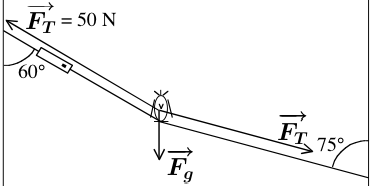
sin(75) = 43.3 / FtFT = 44.8
cos(75) = y / 44.8, so y = 11.6
= (43.3 - 11.6) N. Assuming that the bird is not accelerating, I know that all the forces should add up to zero: + +  = 0 = 0-43.3 + 25 + 43.3 - 11.6 + = 014.4 + = 0 = -14.4 |
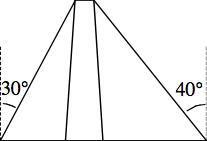
The next two questions refer to the picture to the right. A tower is supported by two wires that are connected to the ground. One is at an angle of 30° away from vertical, the other at an angle of 40° away from vertical.
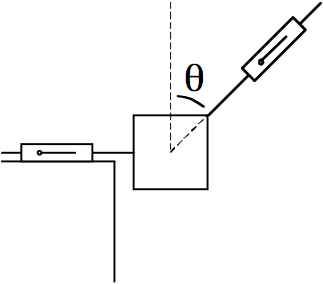 = (-30 + 52) N 3) = (30 + 35.8) N = -5 N and = -5 N